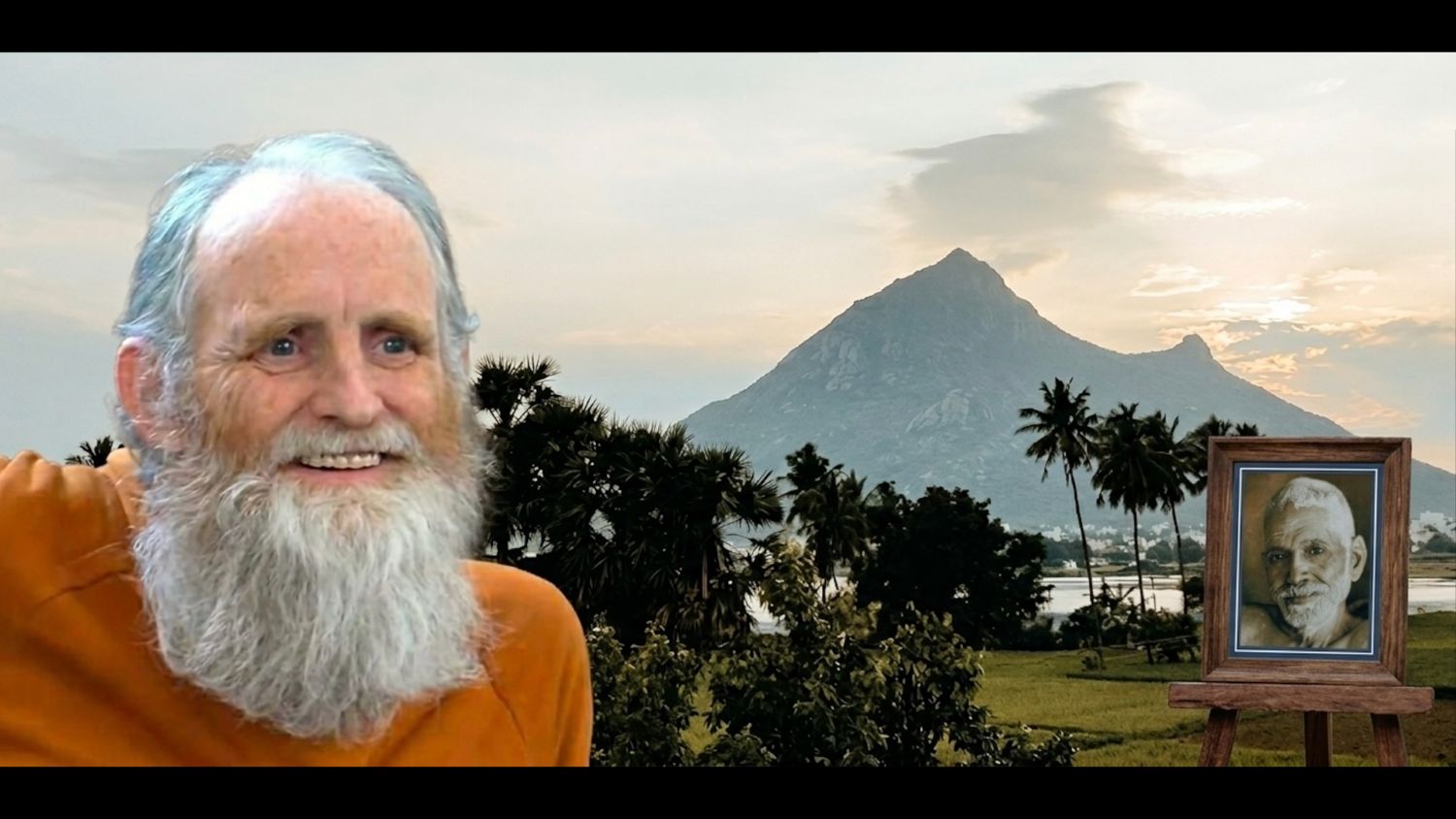
Sri Michael James
In my estimation, Sri Michael James distinguishes himself as a paramount exponent in propagating the teachings of the esteemed Shri Ramana Maharshi. His aptitude for elucidating the philosopher's principles is unparalleled, fostering a deep and resonant understanding in those who have the privilege of learning from him. Sri Michael's fluency in Tamil further enhances his ability to convey the essence of Shri Ramana's wisdom with exceptional clarity and precision. I offer my sincere gratitude to Sri Michael James for his tireless dedication to correcting the widespread distortions of Shri Ramana's teachings, and for illuminating his profound insight and unwavering devotion to his revered guru, Shri Ramana Maharshi.
https://youtu.be/8d_KQU27s8I?si=iowirnxoBuYbbZM8
https://youtu.be/HNWhknBp4Ng?si=2wvnYMuP2KemXnkY
https://youtu.be/Xlm3e9tzPpg?si=UXlhnGUdShgsKvw3
https://youtu.be/Al95lPHfVkg?si=7exe9fbDXS9bUUx6
The following: An enlightening discourse by Shri Michael James, elucidating the concepts of Ajata, the principle of non-origination; Dristi Srishti Vada, the theory that perception precedes creation; and Srishti Dristi Vada, the counter-theory asserting that creation precedes perception.
Michael:
"Advaita is an interpretation of Vedanta. Vedanta is the oldest of the Upanishads which are part of the Vedas. There is what is called the Vedanta Prasthana Traya: (The Triple Canonical Base of Vedanta Scriptures followed by Shankara.) The earliest source are the Upanishads. The other two sources are the Bhagavad Gita and the Brahma Sutra. The Brahma Sutra is something like a philosophical summary of the Upanishads, expressed in sutras. Sutras are something like aphorisms. So the Brahma Sutra can be interpretation in many different ways.
So the different interpretations of Vedanta all base their interpretation on these three sets of texts. There are things in the Upanishads that can support all different interpretations of Vedanta. Like all spiritual teachings there are different levels of teaching given to suit people at different levels of spiritual development. So, Vedanta caters for people at all levels of spiritual development. From the Advaita perspective, Advaita is the ultimate interpretation of Vedanta. Those who interpretate Vedanta differently will not agree with this summary.
Even within Advaita there are many different levels of understanding. A lot of Advaita (53:55) are based on the commentaries of Adi Shankara on the Prasthana Traya.
Adi Shankara tried to broaden the appeal of Advaita to make it more acceptable to a broader audience. So, often his commentaries were written for those who were not naturally drawn to Advaita, so often he had to say things in a nuanced way and often in a little bit diluted way to suit different levels of understanding. So, since the time of Adi Shankara people have understood his commentaries and understood Advaita in different ways.
Shri Ramana Maharshi pointed out that in Advaita the existence of the world, the creation of the world, the ultimate truth expressed in Advaita is what is called Ajata. (Ajata means unborn. According to Ajata, nothing - neither the world, soul, nor God - ever comes into existence. Nothing has even appeared to come into existence.
So, Ajata is quite contrary to our experience. We say that my experience disproves that, because obviously something, even if it not real, at least it appears to exist. It appears to come into existence. It seems to exist. So, Ajata is what Ramana said - it is not a teaching, it is the ultimate truth. But the teaching has to be given to suit those who need the teaching and those of us who are aware of the seeming existence of this world - whether it actually exists or not - it is to make at least we were aware of an appearance of a world and were aware of our self as a small person in in this world and consequently we have problems and we are caught up in what is called - Samsara, this embodied existence. So it is for us the teaching is given.
So, as Ramana said Ajata is not a teaching; it is contrary to your experience, still it is the ultimate truth. Because in Ajata, there is nobody to be taught, nobody in need of any teaching. It is alone what is. So, the highest level of teaching in Advaita is what is called - Dristi Shristi vada.
Dristi means seeing, but in this context means perception. Dristi means perception, Shristi means creation. So according to Dristi shristi vada, there is no creation other than perception. The world does not exist independent of our perception of it.
The classic example of this is dream. In dream we see a world that seems to exist, that seems to be outside our self, but when we wake up from a dream we recognize that dream world had no existence independent of our perception of it.
So, according to Dristi Shristi vada, this waking state is just a dream. and that applies to this world. So the core teachings f Shri Ramana are given from the perceptive of - Dristi Shristi vada.
However, most people are not willing to accept this. So, for those not ready to accept this, Advaita comes down one step to what is called - Shristi Dristi vada. This means, creation precedes perception.
Most religious creation stories are Shristi Dristi vada. Most scientific views about the Big Bang or whatever people consider to be the origin of the universe or whatever are Shristi Dristi vada. The universe exists there, we are born into it and see it. Even forms of idealism or analytical idealism is a form of Shristi Dristi vada because it believes the world existence is independent of our perception of it.
Bhagawan talks from the perspective of Dristi Shristi vada - that nothing exists independent of our perception of it. So, from that perspective, hagawan says, all objects exist in the view of the subject, the subject being ego, and that ego itself is not real. So, objects exist only in the view of the subject, the subject being ego. Objects derive their seeming existence from the seemingly existence of our self as a subject or ego. Ego itself is not real. Because ego appears in waking and dreams, it disappears in sleep. Anything that appears and disappears is not real according to the Advaitic definition of reality.
So, where does ego derive its seeming existence? Ego, Ramana pointed out, is the adjunct conflated awareness - I am this body. The ego is always aware of itself as that I - I am a person, I am such and such identification with a body.
When Bhagawan talks about body, he is not just talking about physical body. Body is a form of five sheaths. The five sheaths mean the physical form of the body, the prana or light that animates the body, the mind, the intellect, and will that functions within it.
So, this packet of sheaths is what we experience our self as. It is a false sense of self-awareness - I am the body.
So long as we are aware of our self as this body, we are aware of other things. In Advaita, they talk about Vasanas (A vasana literally means 'wishing' or 'desiring', but is used in Advaita in the sense of the sub-conscious or latent tendencies in one's nature.)
Vasanas are the seeds that give rise to all these likes, dislikes and so on. Vasanas are best translated in English as inclinations. So, we have certain inclinations which give rise to likes and dislikes; likes and dislikes which then give rise to fears and attachments.
So, all this is the person we take ourselves to be. The ego or I takes itself to be this person, I am this body.
Ego is adjunct ( thing added to something else as a supplementary rather than an essential part.) ( conflated : to combine two or more separate things, especially pieces of text, to form a whole) conflated form of awareness. But in the case of the ego, it is mixed with conflated adjuncts. So, we are aware as this bundle of five sheaths called body and so long as we are aware of other things, so the world exists in our view only when we arise as ego, and consequently are aware of our self as I am this body.
So, according to Bhagawan the world, all phenomena, phenomena of all kinds, mental or physical, all derive their seeming existence, from this seeming existence of our self as ego.
Ego is the adjunct conflated awareness - I am this body. In this adjunct conflated awareness, this body is the adjunct. The pure "I" is just awareness of itself as awareness - the awareness of our own existence. That - according to Advaita and according to Bhagawan - alone is what is ultimately real.
Ego derives its seeming existence from our real existence - our real SELF, I Am; pure awareness, pure happiness, what is called sat-chit-ananda.
The meaning of the individual words of Sat, Chit, Ananda, are as follows:
* Sat: truth, absolute being or existence - that which is enduring and unchanging.
* Chit: consciousness, understanding and comprehension.
* Ananda: bliss, a state of pure happiness, joy and sensual pleasure.
This is what we actually are. According to Bhagawan that alone is what is real. That alone is what actually exists.
Everything else is an appearance. And there cannot be an appearance without someone to whom it appears. And that is what Advaita says, 'the world is mabata' - an illusionary appearance.
Bhagawan is always emphasizing the practical application of Advaita. Bhagavan says, yes, the world is an appearance, but to whom does it appear to. Obviously it appears to me.
So to find out of what is known, we first need to know the truth of the knower. So, we first need to investigate our self and know the truth of everything else, and the truth of everything ultimately is our own being, the pure awareness, I Am."
Michael James - Shri Ramana Maharshi authority.