Examining The Inner Map
While no unsolicited advice is intended here, I have found through years of personal writing that revisiting one's own past sentiments offers a uniquely pragmatic and illuminating form of self-reflection.
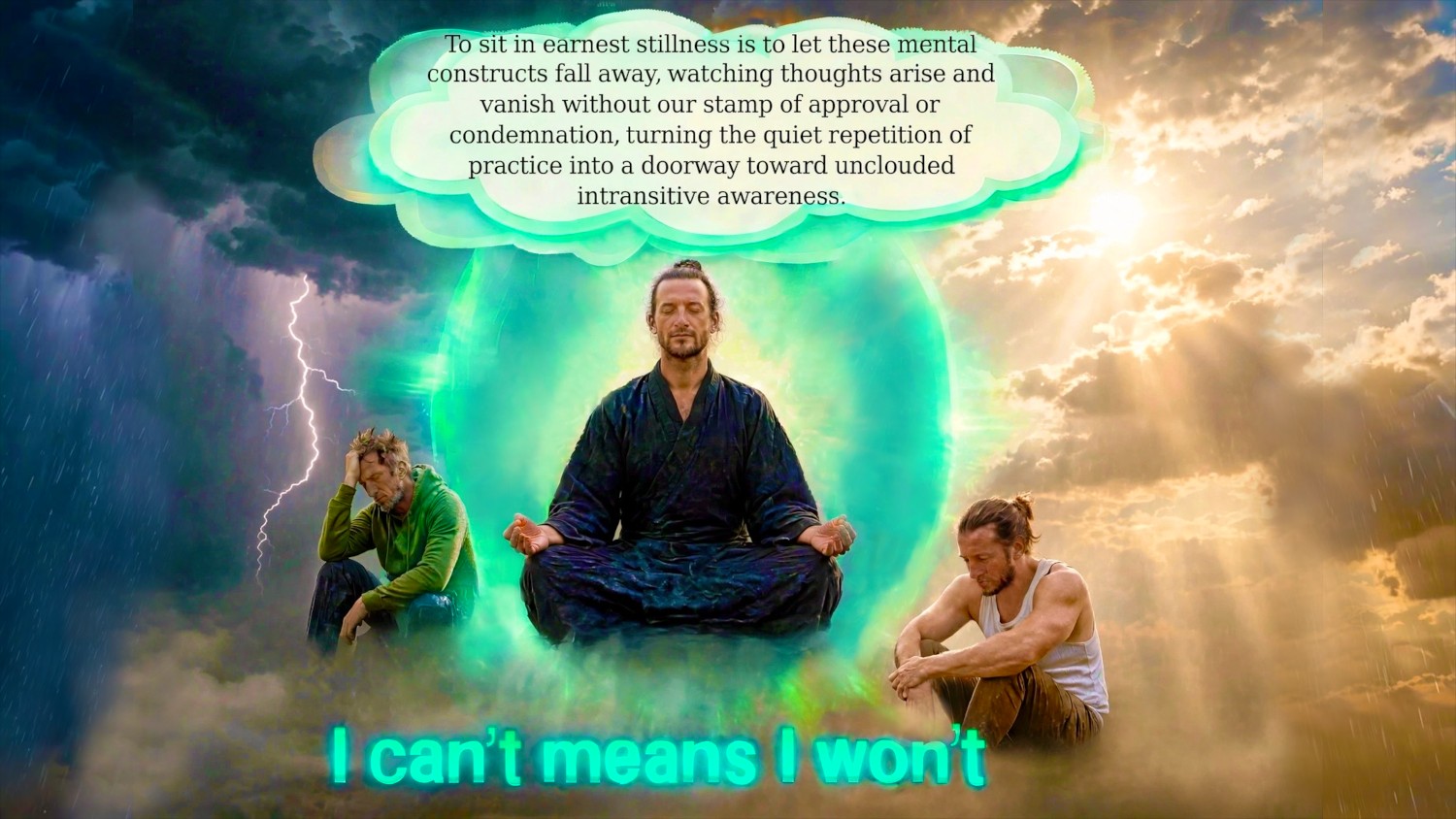
In the austere quietude of Zazen sitting, the mind invariably strives to compartmentalize every shifting state, hastily branding a sensation as either an epiphany to be seized or a nuisance to be banished. Yet, in that very act of categorization, the present moment slips away. True presence resides beyond the ceaseless pendulum of grasping and aversion. Whether the mind swells with satisfaction or chafes against difficulty, both impulses are merely the unhealthy ego trying to steer the vessel away from the steady anchor of the breath. To sit in earnest stillness is to let these mental constructs fall away, watching thoughts arise and vanish without our stamp of approval or condemnation, turning the quiet repetition of practice into a doorway toward unclouded intransitive awareness.
It strikes me as profoundly misguided if I was to tell someone treading a spiritual path that inner work is entirely unnecessary, regardless of their current maturity. Asserting that the ego requires no attention simply because it is ultimately an illusion often fosters a dangerous spiritual bypassing - a lazy abdication of personal responsibility that replaces rigorous self-inquiry with an ungrounded, anything-goes complacency.
When a seeker turns toward guidance, they bring the accumulated architecture of a lifetime’s identification. This includes the most stubborn cages I build for myself: well-worn behavioural ruts, cyclical thought patterns, and the familiar personas worn for protection. This is the dense, somatic footprint of my conditioning - comprising the quiet desperation for approval, codependent habits, sycophantic leanings, narcissistic armour, and the dissociative loops through which the nervous system attempts to flee from old emotional pain.
To be thoroughly identified with these states is to live entirely without a witness, trapped as a merely reactive entity whose every view is dictated by attraction and repulsion, acceptance and denial.
From where I stand now, surveying the landscape of my own psycho-spiritual integration, I see how vital it is to map out the exact territory of one's own unconscious reactivity, parochial blind spots, and subtle self-absorption - including the rigid dogmas, covert biases, and inherited assumptions I rarely question. I once believed myself immune to such egocentricity, until life and patient mentorship shattered the ramparts of my denial, revealing just how meticulously I had insulated myself from discomfort. Left to fester in the dark, these unexamined shadows inevitably breed confusion and entrench clinging, translating directly into somatic and psychological distress. Yet, through years of stumbling forward, I began to learn the art of simply witnessing what arises without instantly reacting. This shift was transformative, though painfully slow. It gradually unlocked a deeper capacity for compassion, allowing me to meet my life without reaching instinctively for the heavy armor of prejudice.
As the journey grew more refined and demanding with every passing year, two realizations crystallized with unmistakable clarity. The first was the insidious pull of victimhood, masked by a passive, spiritualized helplessness disguised as 'I can't' - when the truer confession is often 'I won't'. To truly awaken to the texture of reality, I had to accept a humbling truth: what I so often championed as objective reality was nothing more than the stubborn conviction of my own ego. Rather than questioning life with an open heart, I had routinely surrendered to visceral moods and unexamined interpretations, confusing my private perspective with universal truth. Whenever I retreated behind the phrase 'my truth', I was almost always defending a fixed, subjective stance - unknowingly cementing the very biases I had set out to dissolve.