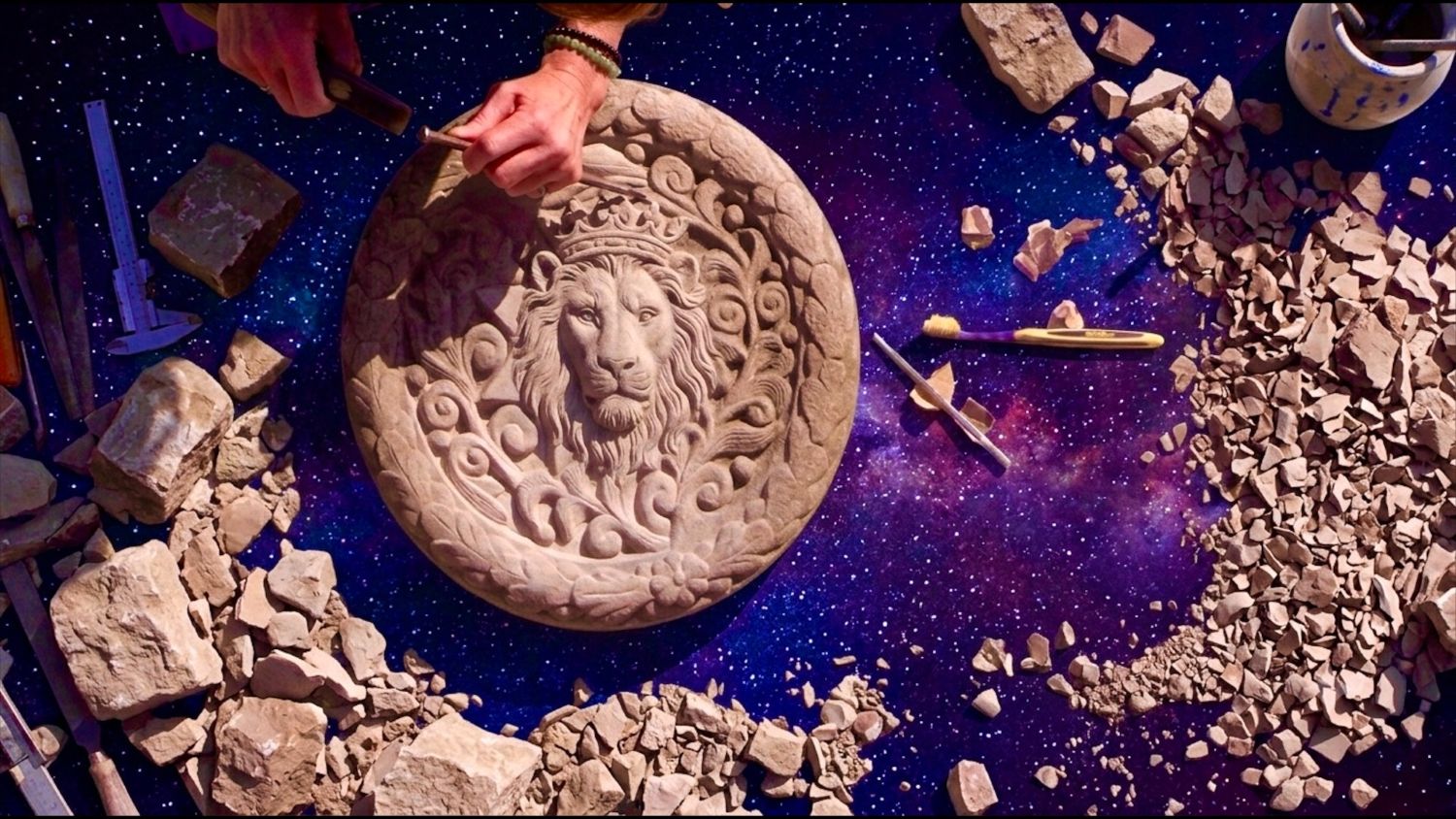
Chiselling Away To Reveal The Statue Within
In the intricate dance between the healthy and unhealthy ego, we find ourselves grappling with the constructs we have built around our identities. The unhealthy ego, with its relentless clinging to an artificial sense of self, perpetuates a cycle of suffering that is deeply rooted in attachment and aversion. This journey of self-discovery reveals that to dismantle these false identities, we must engage in profound inner work, akin to chiseling away at a block of marble to reveal the statue within.
As I navigated this path, I learned that my suffering stemmed from my entanglement with ephemeral thoughts and emotions. Each time I identified with these fleeting experiences, I found myself trapped in a web of distorted self-perception, which only deepened my pain. The realization struck me: by tethering my identity to the transient, I was perpetuating a cycle of automatic reactions, seeking validation while avoiding anything that felt misaligned with my constructed self.
The key to liberation lies not in suppressing emotions or avoiding introspection, but in mastering the art of allowing thoughts and feelings to flow through without clinging or resistance. My true essence emerges as the observer, witnessing the ever-changing panorama of my thoughts, free from the confines of a rigid identity.
Central to this transformative journey is the imperative to free my mind from the habitual pull of attachment to fleeting thoughts and feelings. Through mindfulness, I have cultivated a practice of observation, enabling me to perceive the fluidity of existence, which once seemed solid and unyielding.
While my experience may be unique, it often feels like traversing a dream — drifting through life, driven by an underlying anxiety to survive and thrive. In this state, I inadvertently constructed an elaborate facade for my ego, encapsulating my sense of 'I'.
The ego, in its relentless pursuit of identity, erects barriers around what it deems 'mine', reinforcing its existence through attachments and labels. To transcend this illusion requires immense courage and inner strength — a truth I have come to embrace.
True self-awareness blossoms when I accept the transient nature of existence without resistance. This acceptance weakens the grip of attachment and aversion, which are the twin anchors of my ongoing suffering (dukkha).
To free myself from the psychological entanglements of my conditioning, I must confront my thoughts, feelings, beliefs, and instincts with honesty and presence, unravelling the emotional knots tied to societal and familial narratives that inhibit my authentic self.
The ultimate goal is to awaken to this higher consciousness, evolving from a mere reactive being into a self-aware individual equipped with a nuanced perspective to navigate the complexities of life. This involves recognizing the conventional truths that shape my everyday reality — the realm of language, names, and forms — and understanding the apparent separation between the perceiver (myself) and the perceived (the world around me). While these constructs are useful for daily living, they can obscure the interconnected nature of reality and the dharma.
In the Advaita philosophy of Drishti-Srishti Vada, which posits that perception creates reality, and the Zen Buddhist perspective, we find profound similarities. Both philosophies illuminate the non-dual truth that subject and object are ultimately inseparable.
I remind myself that achieving this liberated state of consciousness requires sincere self-reflection and the bravery to confront the societal narratives and existential fears that have been projected onto my experiences. For this transformative journey, I am eternally grateful to my beloved teacher.
For those committed to this unfolding, I encourage embracing the raw energy of our shared existence to guide our actions meaningfully as we confront and dismantle systems that seek to confine identities for capitalistic gain, masked as cultural 'cleanliness' or hygiene.
I strive daily to embody the spirit of a relentless storm — resisting stagnation while nurturing a healthy, flexible ego through nonconformity and self-examination, inspired by an elusive Truth that fosters a profound respect for life, transcending mere moral debates.
No external force can penetrate the essence of such an aware being without encountering intelligent resistance, revealing untapped potential for creative self-expression within us.
This journey of transcendence is not for the faint-hearted. It demands a courageous honesty about oneself and a deep compassion for the hidden wounds inflicted by society through subtle — often unnoticed — means of control and indoctrination.
The process of slowly breaking down requires meticulous examination of thought patterns and behavioural shifts influenced by unseen forces that many remain oblivious to, quietly reinforcing rigid worldviews.
Peeling back these layers can be arduous, akin to disentangling threads from a frayed fabric.
In my quest to liberate every aspect of myself, I discover an infinite potential fuelled by the creative discontent born from raw authenticity, leading to a life that unfolds with dignity, shedding light on spaces once obscured by habitual 'group think'. It necessitates a measure of dissonance with the self-repressed to pursue a liberated soul, one prepared to embrace life without being weighed down by others' expectations, conditioning, and fears, free from fixed notions of identity. Yet, I must emphasize that, in my experience, without the empathetic support of a mature, highly intelligent, and compassionate teacher, this journey can be perilous.
Every moment, I rewrite my narrative and sense of self with varying degrees of authenticity, liberating myself from the shackles of thoughts and emotions that allow boundless human potential to flourish. As Camus articulated, we are rebels who refuse to succumb to the chains of identity expectations. A life driven solely by inner validation that avoids and suppresses rather than engages meaningfully is one of being 'other-driven' — as the great French storyteller expressed, "The struggle itself toward the heights is enough to fill a man's heart."
At every moment, I craft my unique story — sometimes propelled by inner validation, other times resisting external forces of control and cultural pressure — burdened by the weight of countless unseen influences attempting to dictate and capture my ever-evolving, innermost blueprint.
The cost of freedom is a lifelong commitment — often painful and always transformative — of peeling back the layers of internal conditioning, illuminating what remains concealed in each moment. This arduous process serves as life's grand school, where every moment is a classroom — a potentially excruciating ordeal — hinging entirely on how 'awake' one chooses to be.
Practicing presence and observing emotions without becoming overly entangled clarifies the narrative, illuminating the inner landscape — the personal experience of reality — where unconscious fear loops, past traumas linger, habitual distractions keep one occupied, and a strong aversion to internal discomfort renders one susceptible to manipulation.
Note:
Moving from Ego-Death to Relational Engagement: After his enlightenment, the Buddha had to learn how to exist in the world without the armour of his previous identity. He had to navigate human relationships, deal with betrayals (such as those from his cousin Devadatta), and interact with followers. Mark Epstein argues that the Buddha’s capacity to handle these relational dynamics required continuous, active inner work. - Dr Mark Epstein Author Psychotherapist Buddhist teacher and Psychiatrist