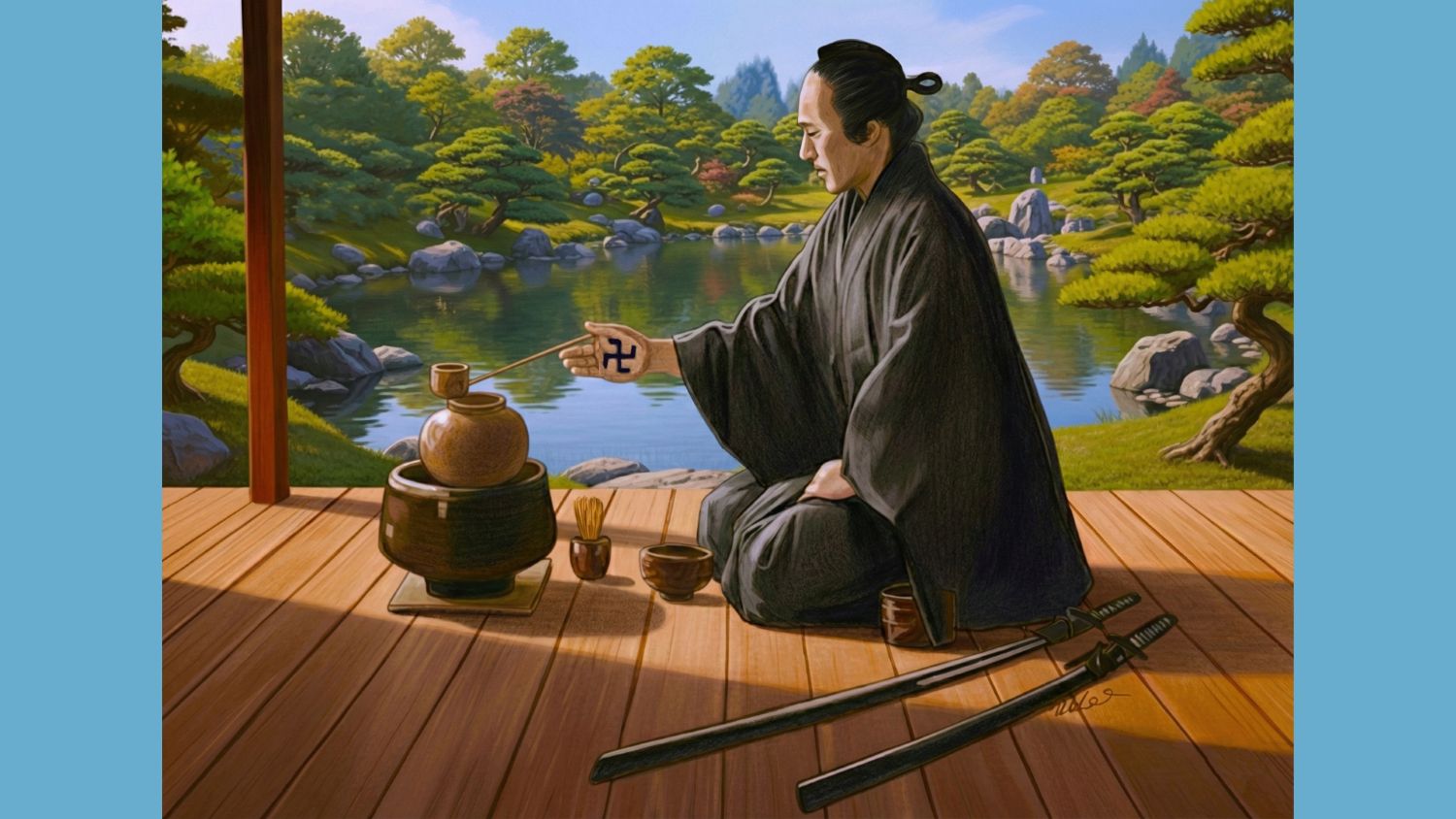
Talk 8
In a very real sense, those who embark on the spiritual path gradually transform into spiritual samurai.
https://www.youtube.com/watch?v=L61o34CCmmo&frags=pl%2Cwn
Zen is sometimes referred to as the warrior's (disciple's) way (Tao) – the way of the disciple. In Bushido, the art of Zen swordsmanship, the opponent is not seen as the enemy but recognized as one's own shadow. The moment one feels enmity (hostility) or fear of death, one is defeated. The Bushido code values loyalty, filial piety and kindness above all else.
Zen focuses on everyday activities such as eating, working and home life. Zen is the business of isness; in Japan, it is called Kono-mama.
Zen also has a strong connection to the samurai through the Bushido code. To embrace and become a living essence and manifestation of this code, the practitioner must clear the mind of all distractions, including fear of death.
During the time of feudal Japan (1603-1868), the country came under the control of the Shoguns from the Tokugawa clan, and this period also gave birth to the samurai class of warriors.
Samurai training was not only about fighting techniques, nor about winning or losing. It also included the art of learning to be fully present by creating free attention.
For the authentic samurai, training was based on spiritual principles such as cultivating the ethics of honour and mastery. Their training also included Sado, the ceremonial preparation of matcha – powdered green tea. For a samurai to be fully present during combat, the art of making tea brought about an understanding of the beauty and simplicity of how tea lives in the moment. The Ikebana flower arrangements reflected their mortality and were performed by samurai before going into battle to reach a state of pure concentration.

"A warrior trains his human heart with flowers and the tea ceremony”, Lord Oda Nobunaga (Kiichi Nakai) states in the movie 'Flower andSword' ('Hana Ikusa')
“There is a spiritual meaning behind the act of arranging flowers”, explains Kimiko Sensei. “Shogyo Mujo means everything changes; nothing lasts. These flowers enable us to enjoy the temporary beauty of nature.This is not just a technique or a skill – it’s a form of inner development, teaching respect, control, patience, tolerance, the importance of making an effort and keeping your mind calm and peaceful”, she added.
From: The Telegraph, Travel on Trial: Finding spiritual enlightenment in the ancient Japanese art of flower arranging, by DanielleDemetriou.

The sword is an inauspicious instrument to kill in some unavoidable circumstances. When it is used, therefore, it ought to be the sword that gives life and not the sword that kills. The point is, however, to utilize the art as a means to advance in the study of the Way (Tao). When it is properly handled, it helps us in an efficient way to contribute to the cultivation of mind and spirit. The sword, therefore, is to be an instrument to kill the ego, which is the root of all quarrels and fighting.
Finally, a story told by Joseph Campbell in the TV series “Joseph Campbell and the Power of Myth” with Bill Moyers, transcribed and commented on by Eric Johnson:
JOSEPH CAMPBELL: Let me tell you one story here, of a samurai warrior, a Japanese warrior, who had the duty to avenge the murder of his overlord. And he actually, after some time, found and cornered the man who had murdered his overlord. And he was about to deal with him with his samurai sword when this man in the corner, in the passion of terror, spat in his face. And the samurai sheathed the sword and walked away. Why did he do that?
BILL MOYERS: Why?
JOSEPH CAMPBELL: Because he was made angry, and if he had killed that man then, it would have been a personal act, of another kind of act, that’s not what he had come to do.
The samurai’s mission was not simply to kill the murderer but to honour his master and fulfil his duty. Killing the murderer out of anger would not have fulfilled the intrinsic call of his duty. To an observer, whether he killed the culprit motivated by honour or anger, it wouldn’t have mattered. The murderer would be dead either way.
But to the samurai, his own motivation made all the difference. He needed a crystal-clear answer for why he was taking action, and a reactive response out of anger would not only be dishonourable, it would negate the reason for his quest.
You can choose your response. You can observe an unhelpful emotion take hold, but you do not have to react. You always can choose to act in a way that honours the vision of the person you truly want to be.
"I define enlightenment as the depth to which one sees the oneness of life, the interconnectedness of life. And the degree of your enlightenment can be measured by your actions." Roshi Bernie Glassman
“People get stuck a lot because they're afraid to act; in the worst case... we get so attached to some end result that we can't function.” Roshi Glassman
Related links:
https://en.wikipedia.org/wiki/Tetsugen_Bernard_Glassman
https://www.amazon.com/Zen-Antics-Thomas-Cleary/dp/0877739447
https://en.wikipedia.org/wiki/Thomas_Cleary
https://www.youtube.com/watch?v=gxwWf-MfZVk
https://excellentjourney.net/2014/12/19/joseph-campbells-samurai-tale/